New Historical Fantasy Books
London in 1666
October 21, 2009
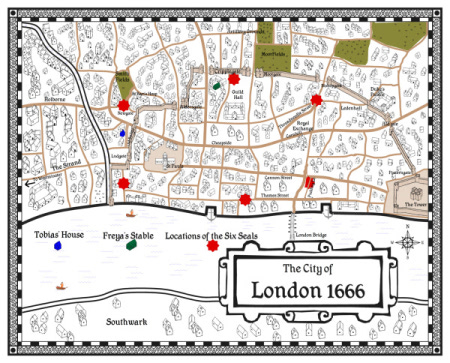
Above: Map of London in 1666 on the eve of the Great Fire
|
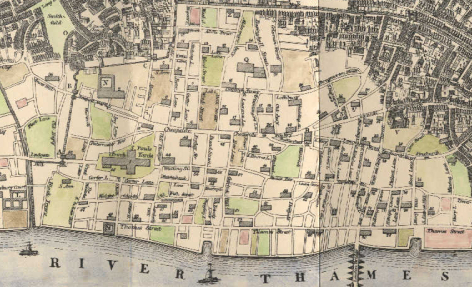
Above: Map of London made in 1667 showing the extent of the damage caused by the fire in 1666. All the light areas were burnt along with the houses, churches amd guildhalls shown here.
By the 1660s, London was by far the largest city in Britain, estimated at half a million inhabitants, which was more than the next fifty towns in England combined. A Roman settlement for four centuries, London had become progressively more overcrowded inside its defensive City wall. It had also pushed outwards beyond the wall into squalid extramural slums such asShoreditch, Holborn, and Southwark and had reached far enough to include the independent City of Westminster.
By the late 17th century, the City proper—the area bounded by the City wall and the River Thames—was only a part of London, covering some 700 acres (2.8 km2; 1.1 sq mi), and home to about 80,000 people, or one sixth of London's inhabitants. The City was surrounded by a ring of inner suburbs, where most Londoners lived. The City was then as now the commercial heart of the capital, and was the largest market and busiest port in England, dominated by the trading and manufacturing classes.
The aristocracy shunned the City and lived either in the countryside beyond the slum suburbs, or in the exclusive Westminster district (the modern West End), the site of Charles II's court at Whitehall. Wealthy people preferred to live at a convenient distance from the traffic-clogged, polluted, unhealthy City, especially after it was hit by a devastating outbreak of bubonic plague in the Plague Year of 1665.
(Extract based upon wikipedia entry)
In The Last Seal it is this London where most of the action occurs, from a chase near the Royal Exchange, the fire starting at Pudding Lane and the dramatic destruction of St Paul's cathedral.
http://www.thelastseal.com/